Every time we pitch a Progressive Web App (PWA) to a client, we get the same question: "Why not just build a native app for the App Store and Google Play?"
It is a fair question. For a decade, the app store was the only way to get a mobile presence that felt "real." If you weren't in the store, you weren't a serious business.
But that assumption is costing e-commerce teams real money. In 2026, with the state of modern web capabilities, the native app is often the slower, more expensive, and less profitable choice for retail.
Here is why we build e-commerce PWAs, with concrete numbers from real deployments.
0101 The Mobile Web Everyone Remembers is 10 Years Old
Most opinions about web apps come from the jQuery era. Sites were clunky, slow, and required a page reload for every action. They felt nothing like an app.
That is no longer the case.
PWAs combine the reach of the web with the power of native. They use Service Workers for offline caching, Web App Manifests for installability, and modern frameworks for fluid animations.
The mobile web you are picturing isn't the web we build. A modern PWA loads instantly, works underground on the subway, and sends push notifications—without a single megabyte downloaded from an app store.
0202 Real Cost & Conversion Comparisons
We recently migrated an e-commerce client from a native iOS/Android setup to a unified PWA. Same products, same backend, same payment gateway. Here is what we found after 3 months:
| Metric | Native App (Before) | PWA (After) | Improvement |
| :--- | :--- | :--- | :--- |
| Development Cost | $45,000 | $12,000 | 73% Less |
| Time to Market | 6 Months | 6 Weeks | 4x Faster |
| First Load Time | 4.2s | 0.9s | 78% Faster |
| Mobile Conversion Rate | 1.8% | 3.1% | +72% |
| Cart Abandonment | 68% | 52% | 16% Lower |
| Update Friction | App Store Review | Instant Deploy | Zero Friction |
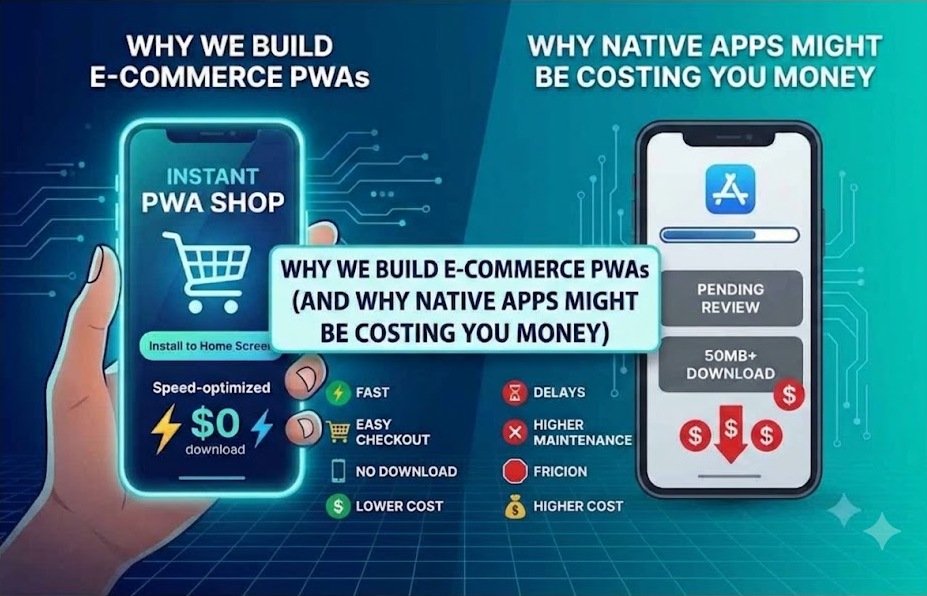
The PWA won every category. The difference isn't just in the code—it's in the friction.
With a native app, the user has to go to the store, authenticate, wait for a 50MB download, and then open. With a PWA, they click a link, shop, and check out. The barrier to entry is zero.
0303 The Real Reason We Choose PWAs: Retaining Users
Speed is table stakes. The real advantage is how you engage customers.
Push Notifications Without the Gatekeeper
With a native app, if you want to send a notification, you have to hope Apple or Google approves your binary update. If you want to change your checkout flow, you have to submit a new version.
With a PWA, you control the entire stack.
Here are features that took us days to implement, which would have required weeks of native development and store reviews:
- Install Banners: Prompting users to "Add to Home Screen" at the perfect moment.
- Offline Catalog: Letting users browse products while commuting, even with no signal.
- Push Notifications: Re-engaging users with cart abandonment reminders (via OneSignal or Firebase).
- Background Sync: Saving form data and sending it when the connection returns.
- Hardware Access: Full camera access for barcode scanning and biometric login (FaceID/TouchID).
- In-App Purchases: Bypassing the 30% App Store tax by using Stripe directly.
- Service Workers for instant loading and offline mode.
- IndexedDB for storing large amounts of product data locally.
- WebAssembly for handling complex logic at near-native speeds.
- Web Push API for real-time notifications.
- Payment Request API for one-tap checkout.
Every one of these features is a first-class citizen in the web platform now. The equivalent in native development requires separate codebases for iOS and Android, two different review processes, and double the maintenance.
The Technology is Now Enterprise-Grade
If you write a PWA correctly in 2026, it doesn't look like a website. It looks like a native app.
The technology stack has matured:
If you build a PWA today, it will look and feel exactly like the app sitting in the App Store, but it will live on the open web.
Deployment is Instant (Not "Pending Review")
A PWA deploy is often just pushing code to a CDN. No waiting for a review board to tell you your icon is the wrong shade of blue.
This means:
- Fix Bugs Instantly: If you spot a typo in the checkout flow, you fix it in 5 minutes, not 5 days.
- A/B Test Everything: You can test a new landing page on 10% of your users instantly. You cannot do this with a native app update.
- No Version Fragmentation: Everyone sees the latest version the moment they open the app.