Every client wants an AI agent now. They want the autonomous workflows, the 24/7 customer support, and the automated data entry. It sounds like magic.
But here is the part of the conversation that usually gets skipped: AI agents are expensive to run.
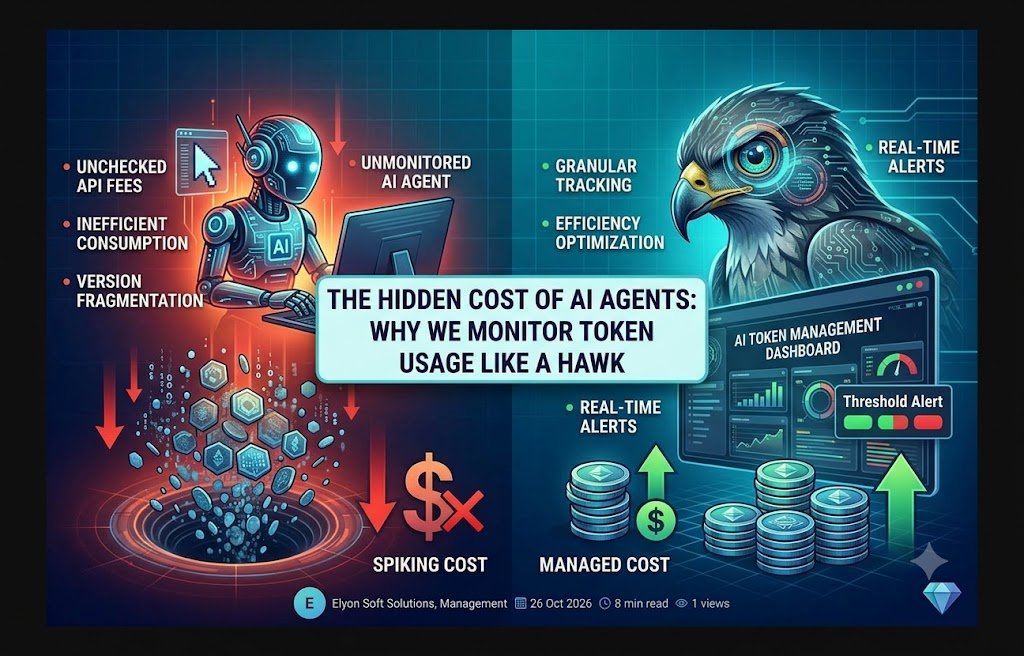
Unlike a traditional SaaS application where your server cost is relatively flat regardless of how many times a user clicks a button, AI agents consume resources (tokens) every single time they think, reason, or act. If an agent gets stuck in a loop, or if a user figures out how to exploit your prompt, your AWS or OpenAI bill can spike overnight.
Gartner recently warned that as AI agents manage tasks independently, "expenses from token usage and APIs can escalate fast." We have seen this firsthand. Here is how we handle it.
01The $10,000 Overnight Mistake
We recently audited a client's AI implementation. They had built a multi-agent system where one agent was responsible for summarizing customer emails, and another was responsible for drafting replies.
One weekend, a customer sent an email with a 50-page PDF attachment. The summarizing agent tried to read it. The context window overflowed, so the agent split the document into 100 chunks and processed them sequentially. Then, the drafting agent read all 100 summaries to write a single reply. The reply was wrong, so the agent tried again. And again.
By Monday morning, that single email thread had consumed 14 million tokens. The cost was over $4,000 for one support ticket.
This is not a unique story. It is a common architectural failure in AI-first products.
02The Three Guardrails We Implement
We treat AI costs the same way we treat cloud infrastructure costs. We implement strict FinOps (Financial Operations) guardrails.
1. The Hard Limit (Rate Limiting by User)
You cannot allow unlimited token usage. We implement hard limits at the API gateway level.
If a specific user session consumes more than a predefined threshold (e.g., 50,000 tokens per hour), the system throws a 429 error and queues the request for human review. It is better to frustrate a power user slightly than to let a bug drain your bank account.
2. The Model Router (Right-Sizing the Brain)
Not every task requires a frontier model like GPT-4 or Claude 3.5 Opus.
We build a routing layer. If the task is simple (e.g., extracting a name from an email), we route it to a smaller, cheaper model (like GPT-4o-mini or Claude Haiku). If the task is complex (e.g., writing a legal brief), we route it to the expensive model.
In our benchmarks, 80% of agent tasks can be handled by a smaller model with zero degradation in output quality. This alone cuts API costs by 60-70%.
3. The Loop Breaker
Remember the email client from earlier? The agent got stuck in a loop. We fix this by setting a maximum "turns" limit on every agent workflow.
If an agent attempts the same action three times and fails, the workflow terminates and alerts a human. It sounds simple, but many developers forget to implement it because they are focusing on the happy path.
03The Trade-Off
Building these guardrails takes time. It requires instrumenting every AI call with logging and monitoring. It means writing custom code for routing and rate limiting.
But the alternative is worse. If you launch an AI product without cost controls, you are one bug away from a financial disaster.
AI is powerful. But in 2026, the teams that win are not just the ones with the smartest agents—they are the ones with the most stable economics.